
Richmond Juvenile Release Destinations
Richmond Juvenile Detention Center provides temporary secure custody before juvenile adjudication or disposition. It is operated by the City of Richmond Department of Justice Services, not the Richmond City Sheriff's Office. That distinction controls where release questions go. The adult Sheriff's Records Department and adult JailTracker do not serve as a public index of the center's residents.
A young person may leave detention under a juvenile court order, return to a parent or guardian under stated conditions, enter another court-directed placement, or move through another authorized juvenile process. The precise outcome is case-specific and protected. Public sources do not provide an adult-style release disposition, photograph, or open roster that can be used to infer it.
| Question | Correct Richmond channel |
|---|---|
| Has the court changed detention? | Counsel or the Juvenile and Domestic Relations District Court |
| May an authorized person receive details? | Detention administration using its identity and authority process |
| Where should school work go? | Facility education staff and the student's home school |
| Is there a public online case result? | No public Virginia online juvenile case display |
Release from secure detention also does not reveal whether court conditions remain. Only the court order and authorized case contacts can explain the next legal status.
Confirm Richmond Juvenile Releases
The safest confirmation begins with the person's lawful relationship to the case. A parent, guardian, or lawyer should use the contact details already provided by the court or detention staff. A member of the public should not expect the center to disclose whether a named minor is or was held.
- Gather the court name, case information already lawfully available to you, and proof that you are authorized to receive information.
- Contact counsel first when a lawyer represents the young person. Counsel can read the current order and identify the responsible court office.
- Call detention administration for operational questions that the facility is allowed to answer. Follow its identity and authorization process.
- Use the Juvenile and Domestic Relations District Court for court-order questions. Do not substitute the public adult case search.
- Coordinate pickup, placement, and school matters only through the instructions given by the court, facility, or authorized case worker.
The absence of a juvenile from an adult roster proves nothing. Richmond's adult JailTracker, adult VINE record, and adult booking-photo rules are separate systems.
For adults held at the city jail, the process is different. The Richmond City release search explains RCJC records, VINE, court, state, and federal checks. That adult path should not be copied into a juvenile case.
Richmond Juvenile Release Contact
The official Richmond Juvenile Detention Center page identifies the city facility and its main telephone number. Staff may limit any response to protect the young person's privacy. Callers should be ready to explain their lawful role rather than ask for a public custody lookup.
Richmond Juvenile Detention Center1700 Oliver Hill Way
Richmond, VA 23219
Main telephone: 804-646-2937
Operator: Richmond Department of Justice Services
The research does not identify a public release-record line, public release hours, or a walk-in records schedule for juvenile matters. Do not assume the adult RCJC Records number applies. An authorized parent, guardian, or counsel should ask detention administration which office owns the requested case or placement information.
The official Richmond facility page is shown below. Its city agency context matters because similarly named adult or county facilities can appear in broad web results.
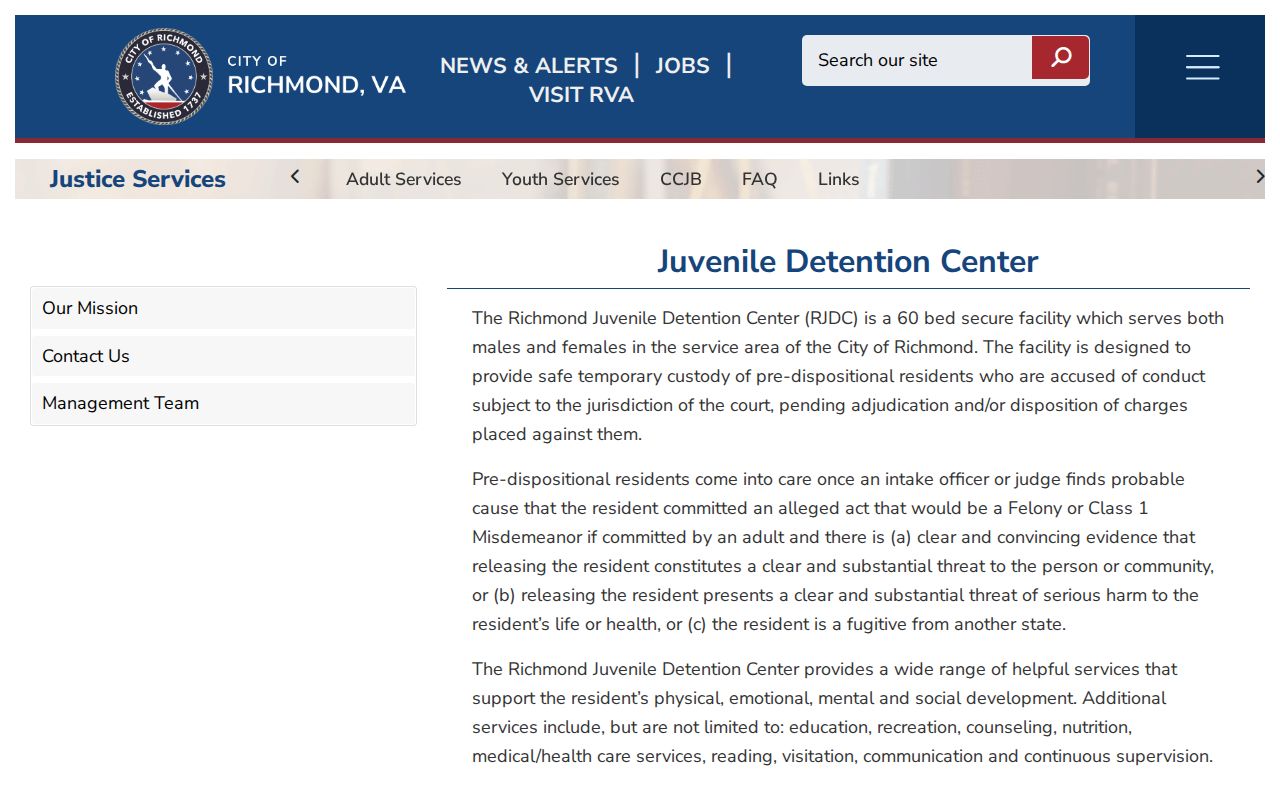
The contact shown by the city is the proper starting point for authorized facility questions, not an open public roster search.
Richmond Juvenile Detention Role
The Richmond Juvenile Detention Center is a 60-bed secure facility for young people awaiting adjudication or disposition. “Adjudication” is the juvenile court's finding stage. “Disposition” is the stage when the court sets the response or placement. These terms do not map neatly to adult conviction and sentencing labels.
Temporary detention is not proof of a final court outcome. A young person may be held while the court considers safety, appearance, placement, or other lawful factors. The later court decision may change custody, but the public does not receive the same open record fields commonly associated with an adult booking.
The center also transfers educational work back to the home school after release. That task is part of continuity for the student. Questions about records, assignments, or reenrollment should follow the authorized facility and school channels, with the young person's privacy preserved.
Educational coordination does not turn the custody event into a public record. School staff, detention educators, and family members have different roles, and each should receive only information allowed for that role. An authorized adult can ask who will transmit assignments, whether the home school has received the work, and which office handles a missing packet. Those practical questions are distinct from asking a public search engine to reveal a juvenile case outcome.
Richmond Juvenile Release Record Limits
Virginia's online court search does not publish juvenile case information. The Virginia court search guidance makes that boundary important: a failed public search is expected and does not prove there was no detention, hearing, release, or placement.
The court-search limit is shown below through the official Virginia court source. It is the reason a public name search cannot be used to check a Richmond Juvenile Detention Center release.
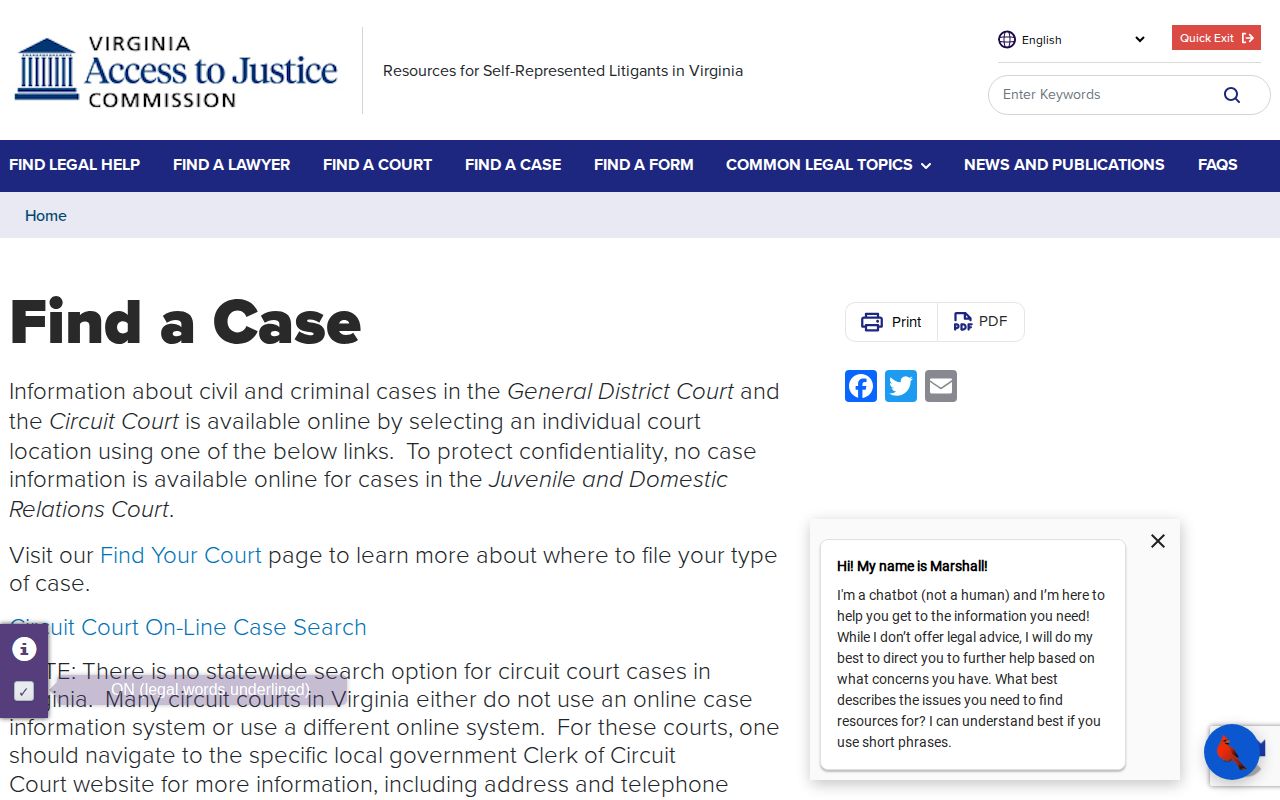
Authorized case participants still have routes through counsel, the court, and detention administration. Those offices can apply the access rules to the specific relationship and record. A general public-record request should not be described as a guaranteed way around juvenile confidentiality.
- Confidential
- Access is limited by law or court rule rather than offered through a public name search.
- Adjudication
- The juvenile court stage that determines whether the allegations are sustained.
- Disposition
- The juvenile court order addressing the case after adjudication.
- Authorized person
- A person whose role and identity allow the facility or court to provide information under its rules.
Keep Richmond Juvenile Releases Separate
Richmond City has two different custody settings in the facility map. RCJC is the adult city jail under the Sheriff. The juvenile center is a pre-disposition youth facility under Justice Services. Their records, operators, search methods, and disclosure rules are not interchangeable.
The adult system may use JailTracker, Virginia Jail VINE, a Sheriff release record, adult court disposition, and an adult booking-photo request. None of those channels should be presented as a public juvenile roster. VADOC and NAAVI concern state corrections and eligible state notifications, not a universal search for young people held by the city.
A broad commercial search can also mix Richmond City with a different Virginia locality or combine adult and juvenile references. The official city page, counsel, and the proper court are the sound sources. Protecting that boundary reduces both false status claims and needless exposure of a minor's case.
The Richmond City General District and Circuit Court adult pages are also not substitutes for the Juvenile and Domestic Relations District Court. An adult felony may move from General District Court to Circuit Court, but that public two-court trail does not describe a juvenile proceeding. A parent or guardian who has authority should use the court contact supplied in the case papers. Counsel can identify whether the current question concerns detention, adjudication, disposition, placement, or a later review.
Richmond Juvenile Release Planning
Planning for a court-directed departure should follow the instructions supplied in the case. Pickup authority, destination, services, and timing can depend on the order and the young person's placement. The research found no public fixed release-time policy, so families should not infer a schedule from adult jail practices.
Parents or guardians can ask the authorized contact what identification to bring, where to report, and how school work will be returned. Counsel can clarify the order and any continued court conditions. Detention staff can address facility procedures within the information they are allowed to share.
No public result should be treated as a substitute for direct confirmation. Juvenile privacy is not a missing-data problem to solve with wider searches. It is a legal and practical boundary that directs the question back to the people responsible for the case.
Release-day details can change when the court issues or amends an order. Families should confirm instructions through an authorized contact before traveling. The facility page does not publish a fixed exit, pickup window, or release cadence, so an adult jail schedule, transit assumption, or third-party directory should not fill that gap. Direct confirmation protects the young person and avoids a failed pickup based on stale or unrelated information.
Richmond Juvenile Release Sealing
Virginia's sealing and expungement rules can further affect record access. The current statutory collection begins in Virginia Code Article 6.2. The effect depends on the record and order, so no public absence should be read as proof that an event never occurred.
Only the custodian or court can apply the current rule to a specific record. A person seeking advice about their own juvenile matter should use counsel or an appropriate court resource. Facility staff can explain their administrative route but cannot replace legal advice.
Note: Adult intake-photo disclosure rules do not create a matching public right to a juvenile booking photograph.