
Richmond City Parole Versus Probation
Parole and probation both allow a person to live outside a secure facility while legal controls remain. They begin in different ways. The Virginia Parole Board decides discretionary parole and certain conditional-release matters. The Virginia Department of Corrections, usually called VADOC, provides field supervision through district offices. A Richmond court orders probation. State probation is supervised by VADOC, while Richmond Justice Services handles distinct local pretrial and local probation programs.
Physical release is not final discharge. A person may have left the Richmond City Justice Center or a state prison but still owe reports, testing, approved-residence duties, or other case-specific terms. The controlling order and supervising agency identify the status.
| Point | Parole | Probation |
|---|---|---|
| How it begins | A Board grant for an eligible prison sentence | A court order, with or without an active jail or prison term |
| Richmond state supervisor | VADOC Richmond District 1 | VADOC Richmond District 1 for state probation |
| Local layer | Not created by Richmond Justice Services | Justice Services may handle local probation or pretrial supervision |
| Best first record | Board decision plus VADOC custody or supervision record | Sentencing order plus VADOC or local office confirmation |
- Parole
- Conditional release from prison for a person whom Virginia law makes eligible.
- Probation
- Court-ordered supervision in the community, sometimes after active time and sometimes instead of it.
- Discharge
- The formal end of supervision, not merely departure from a jail or prison.
- Absconder
- A supervisee alleged to have stopped reporting or otherwise left supervision without authority.
Verify Richmond City Post-Release Supervision
Start with the authority that imposed or granted supervision. The VADOC Inmate and Supervisee Locator covers people in state custody and people still under VADOC probation or parole supervision. Search by a seven-digit DOC ID when known. A name search needs the first three letters of the first name and the full last name; location, race, gender, and age-range filters can narrow a common name.
- Check the Richmond court record or parole decision to identify whether the matter is probation or parole.
- Run the VADOC locator and compare the DOC ID, name, age, and listed location. A district-office placement can show community supervision after prison release.
- Use the VADOC office directory to confirm that Richmond District 1 is the listed reporting office.
- Call that office for an allowed status check. For locally ordered pretrial or local probation, contact Richmond Justice Services instead.
- Request the sentencing, Board, or correctional record when a durable record of supervision or discharge is needed.
The locator updates daily, yet VADOC warns that information can be wrong or stale. It does not promise a lasting public entry after final discharge. A no-result therefore cannot certify that supervision ended. The sentencing court or VADOC record is stronger evidence.
For the full custody and release chain, the Richmond City released inmate search explains when RCJC Records, VINE, and a court record should be added.
Richmond City Supervision Office
Richmond District 1 serves the independent City of Richmond. It is the correct local VADOC contact when the locator lists a Richmond community placement. It is not the Sheriff Records Department and cannot substitute for an RCJC release record. The supervising officer controls the actual case plan, so a general web description cannot establish one person’s schedule or conditions.
VADOC Richmond District 1
6866 Everglades Drive
Richmond, VA 23225
Phone: 804-786-0251
The official office directory is the best source for current office information. Its Richmond District 1 listing also helps distinguish a state supervision placement from local Richmond Justice Services. The image below shows the official directory rather than a third-party office listing.
Open the VADOC facilities and offices directory before using its contact details.
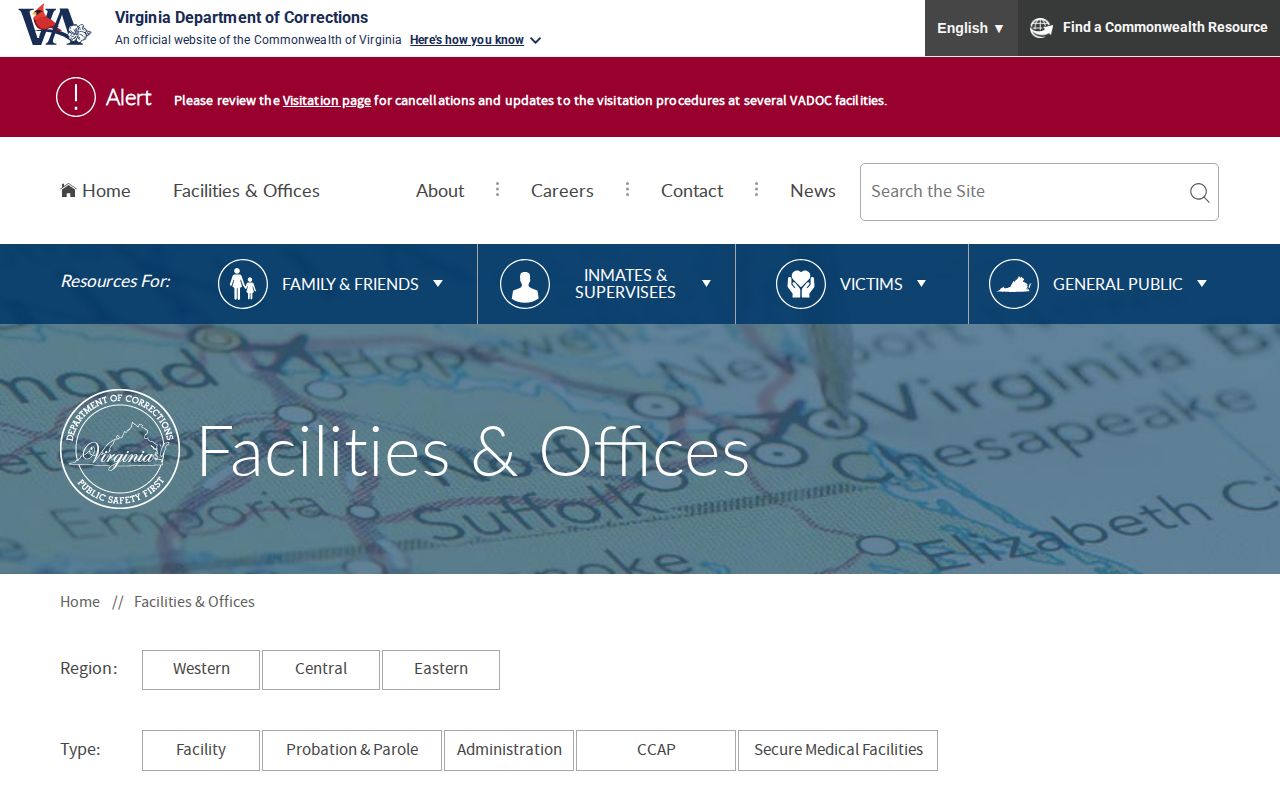
The directory places the local office in the state supervision system and helps route a Richmond City parole or probation question correctly.
Richmond Justice Services Adult Programs, at 306 N. 8th Street, can be reached at 804-646-8955. Pretrial services uses 804-646-0331. Office hours are Monday through Friday, 8 a.m. to 5 p.m.; published intake periods are 9 to 11 a.m. and 1 to 3 p.m. Those programs are separate from parole.
Note: Confirm the listed office from the case record before sharing personal case details by phone.
Richmond City Supervision Conditions
VADOC assigns supervision by risk and case plan. Intensive supervision can involve more office and community contact. Medium supervision follows the individual plan. Low-level supervision may use a monthly biometric check-in and an approved residence. Voice Verification Biometrics uses a monthly interview and directs a participant to report changes within three days. These descriptions are categories, not a fixed schedule for every Richmond City supervisee.
A violation is an alleged breach of a supervision term. It may lead to review, a court capias, an officer PB-15 arrest warrant, or a Parole Board warrant, depending on who has authority. A capias is a court order to take a person into custody. A warrant is not proof that every listed allegation is true, and no one should try to apprehend a person.
The VADOC Most Wanted page is only a curated statewide fugitive list. It may show a photograph, aliases, physical details, the warrant type, and a captured label. Absence from that page proves neither compliance nor lack of a warrant. Its anonymous tip line is 1-877-896-5764.
Review the official VADOC explanation of wanted records to understand the page’s limited scope.
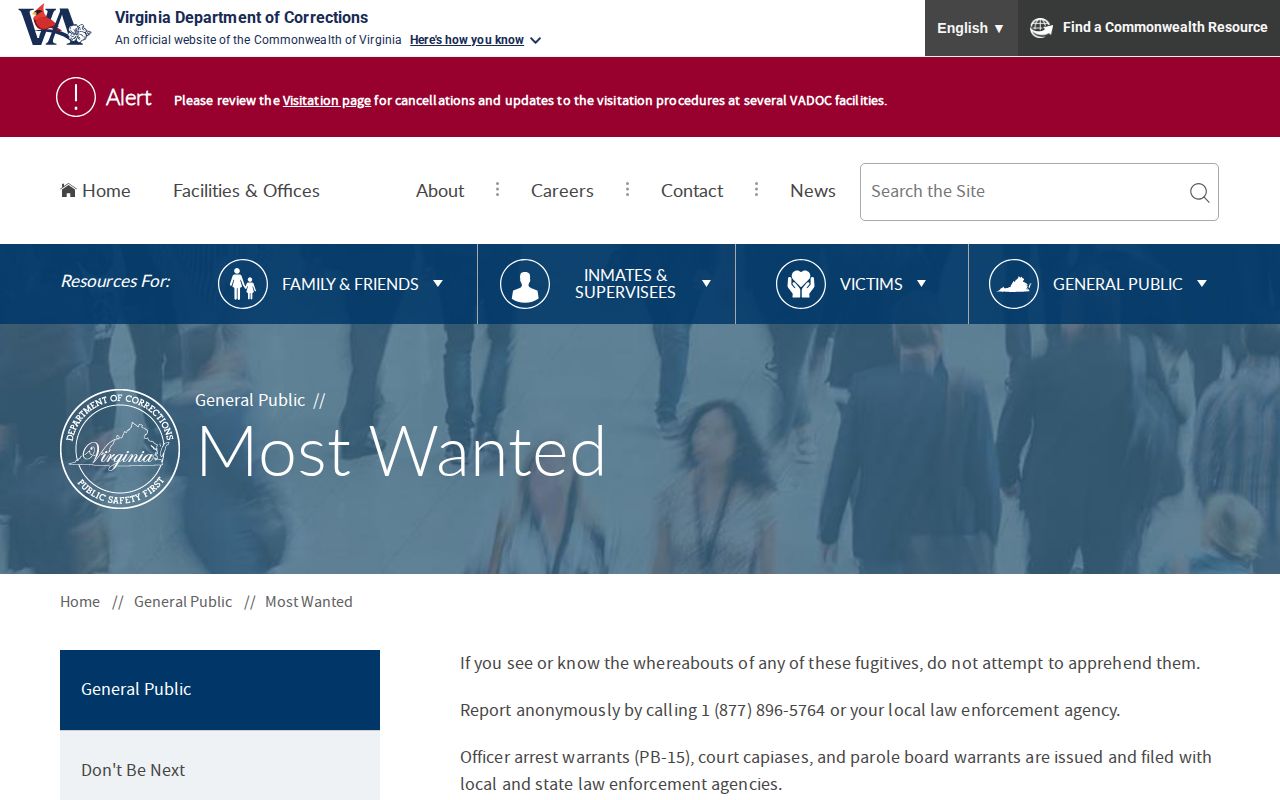
The statewide page can confirm a posted entry, but it cannot clear a Richmond City probation or parole status by omission.
Richmond City Parole Decisions
The Virginia Parole Board publishes an irregular public-meeting calendar. Listings can include the date, time, agenda, live meeting link, and names of people to be heard. Not every eligible person receives a public meeting. Since July 1, 2024, final deliberation and voting must occur in a public meeting, but readers should check the live agenda rather than assume a weekly or monthly cadence.
Monthly parole decision reports are the durable outcome source. Under Virginia Code § 53.1-136, the prior month’s report is due by the fifteenth and includes the person, offense, conviction jurisdiction, sentence facts, time served, grant or denial, reasons, and member vote information, subject to notice timing. A denial may be styled “Not Grant.”
A grant does not mean the person left prison that day. VADOC generally sets release no sooner than 30 business days after notice of a grant, apart from a narrow terminal-illness exception. Confirm the actual exit through VADOC records, the locator, or authorized NAAVI notification. Eligibility itself is complex. Most felonies committed on or after January 1, 1995 are ineligible unless a statutory exception applies, so sentence length alone is not enough to calculate a hearing date.
Other defined groups may qualify under statutory exceptions. These include some people with older jury sentences and some people serving long terms for offenses committed while they were juveniles. Geriatric conditional release has its own framework for qualifying non-Class-1 felony prisoners based on age and years served. As of July 1, 2026, the Board says qualifying geriatric cases are scheduled automatically. None of these rules ensures a grant. The Board must still review the record and publish the applicable result.
The hearing calendar and monthly decision archive answer different questions. The calendar shows upcoming public business. A decision report records the final result for the reporting month. Neither is a substitute for the VADOC record showing when the person actually moved from confinement to supervision.
Richmond City Reentry After Release
The Richmond City Sheriff’s transitional and reentry services connect the custody stage to later supervision. RCJC documents case planning, help obtaining birth certificates, DMV information, home-plan preparation, “Making it on Supervision” seminars, family reunification seminars, resource fairs, and the voluntary G.R.A.C.E. recovery program.
These services do not identify whether a person is on parole or probation. They can help with the practical steps tied to a release plan. A home plan may matter to VADOC supervision, while Richmond District 1 still remains the source for state case instructions. Participation also does not prove final discharge.
RCJC also uses alternative-sentencing paths, such as work release, home electronic incarceration, weekend service, and school release. These are community-custody settings, not parole. A weekend participant can be outside the center between reporting periods and still return to RCJC for ordered weekends. Verify the legal status before routing a question to a parole office.
Richmond City Supervision Discharge
Supervision ends through formal discharge, expiration, or another authorized case action. Successful completion means correctional control has ended, not just that secure custody ended earlier. The VADOC locator may stop displaying a person after final discharge because it is built around current custody and supervision categories. Its silence is not a certified record.
For probation, use the final court order and, when needed, a VADOC or local program record. For parole, pair the Board decision with the later VADOC release and supervision history. An RCJC record only establishes what happened to the jail custody episode. Keeping those sources separate prevents a jail release from being mistaken for the end of every legal obligation.
Note: A released Richmond City person can remain under correctional control until the supervising authority records a formal discharge.