
Richmond City Release Meanings
A Richmond City release record marks the end of one custody episode. It does not always mean that a person walked out of the Richmond City Justice Center into the community. A bond order, dismissal, time-served order, or completed local sentence may lead to physical discharge after jail staff verify the authority and check for other holds. A new sentence, warrant, federal writ, or immigration detainer may instead move the person to another custodian. The agency that controlled the next step determines where the next useful record will appear.
The Sheriff’s public inmate search is a current-custody tool. When a name drops off, the change is only a clue. It may reflect release, transfer, a name mismatch, a lag, or a record outside public scope. Strong confirmation joins two sources, such as a Sheriff release entry or VINE event with a court disposition. If transfer is possible, add the Virginia Department of Corrections, another jail, BOP, or ICE record. Richmond is an independent city. The vendor’s “Richmond_Co_VA” address does not change that city jurisdiction.
Richmond City Release Types
Release words have precise limits. “Bond” means the person left secure custody while the case remains open. “Time served” or sentence completion ends the active local term, though probation or another case may follow. A dismissal ends a charge but does not cancel an unrelated hold. Parole and mandatory release end prison confinement under stated rules, often with supervision. Transfer is continued custody. Death and escape end or change custody status, but neither is an ordinary release.
| Recorded type | Meaning | Next source |
|---|---|---|
| Bond or pretrial release | Out of RCJC while the case remains pending | Richmond court and Adult Pretrial Supervision |
| Time served or local completion | The active local jail term ended | RCJC release entry and sentencing court |
| Dismissal or court order | One case or charge ended or changed | Court disposition plus the jail timestamp |
| Parole or mandatory release | Prison confinement ended under supervision rules | VADOC locator and District 1 |
| Transfer or detainer | Custody continued with another authority | Receiving jail, VADOC, BOP, ICE, or court |
These terms should be read against the booking number and the releasing authority. One person may have several cases. The end of one commitment may not end another. That is why the exact recorded disposition matters more than a bare no-result from a live roster.
Note: Treat every transfer label as continued custody until the receiving agency or court record establishes what happened next.
Richmond City Release Record Fields
The durable Sheriff record should connect the release to a specific adult booking or commitment. Ask for existing data rather than a new explanation. Richmond does not publish a current field dictionary for released records, so request both the fields and any definitions used when the entry was made. A booking photo belongs to intake and cannot, by itself, establish the outcome or present status.
| Field | What it shows |
|---|---|
| Full name and aliases | The identity attached to the custody episode |
| Booking or commitment number | The key tying intake and release entries together |
| Admission date and time | When that episode began |
| Release date and time | When RCJC recorded the episode as ending |
| Disposition or release type | Bond, court action, time served, completion, transfer, or another recorded basis |
| Releasing authority | The court or agency authorizing the action |
| Charge and case identifiers | The matters connected to that booking |
| Destination or transfer agency | Where custody went next, if recorded and releasable |
What does “discharge” mean? It means an agency’s custody or supervision ended. Physical release from RCJC and final discharge from all correctional control are not always the same event.
Note: Request field definitions when a code or short disposition label does not clearly distinguish street release from a transfer.
Request Richmond City Release Records
Richmond accepts Sheriff records requests through a Sheriff-specific form and the citywide records process. A request may also be sent by mail, email, fax, phone, or made in person. It does not need to cite the Freedom of Information Act or use a set form. Precision helps. Include the full legal name, aliases, date of birth, booking number if known, and a narrow date range.
- Check the Richmond Sheriff Records contact and identify the exact adult booking.
- Ask for the booking and release entries, release date and time, recorded disposition, releasing authority, and transfer destination if recorded and releasable.
- Request electronic copies, the applicable retention schedule, and any data dictionary needed to read coded fields.
- Ask for a cost estimate before work begins. Richmond publishes no flat release-record fee.
- Keep the response, any cited withholding rule, and the records together with the court or VINE confirmation.
Richmond City Sheriff Records Department
1701 Fairfield Way
Richmond, VA 23223
804-646-0204
Fax: 804-646-0968
The City of Richmond FOIA guide explains that charges are limited to actual reasonable costs. The agency may seek a deposit when an estimate exceeds $200. Virginia law generally requires a response within five working days, but that is not a promise that all records will be produced by then. An ordinary seven-working-day extension may apply, and some criminal investigative file requests have a longer response path.
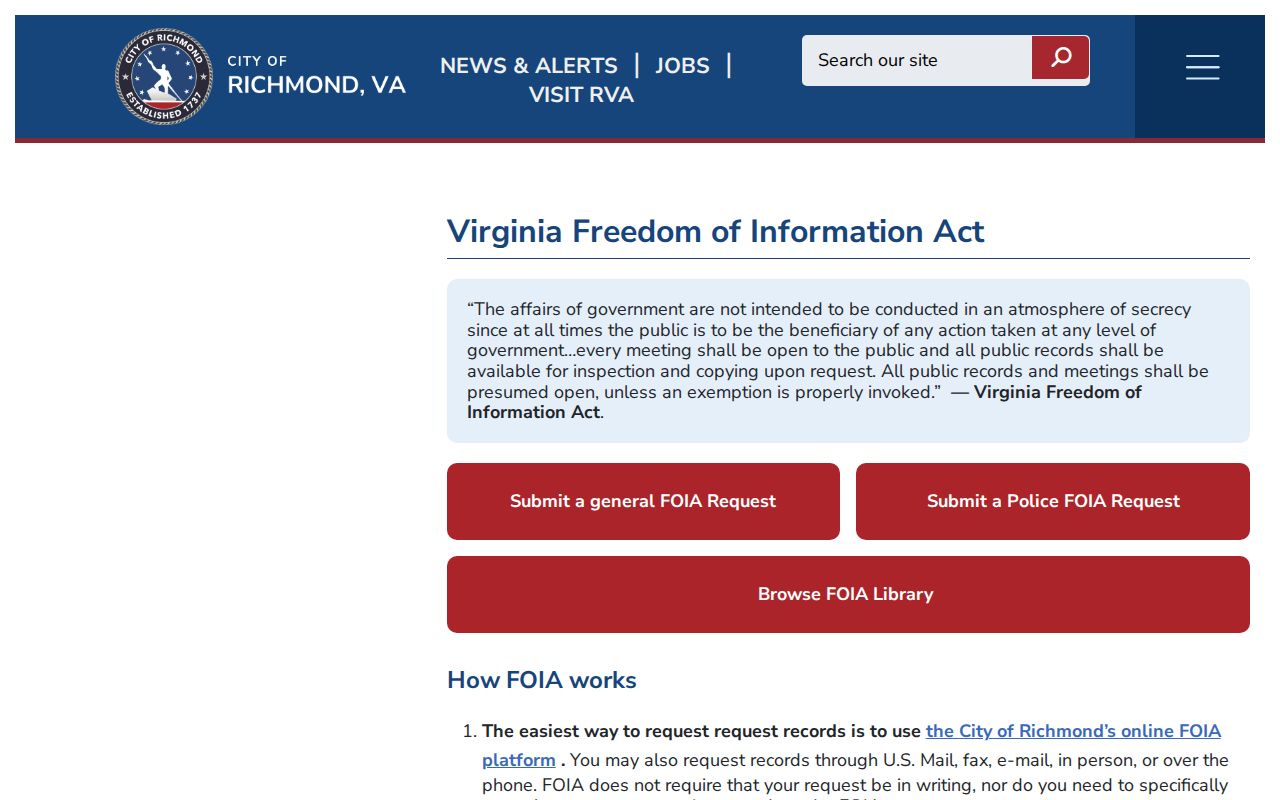
The captured city guide helps locate the official request route, while the request itself should name the exact RCJC booking and release fields sought.
Richmond City Release Record Law
Virginia Code § 2.2-3704 governs access timing, actual-cost charges, deposits, and the duty to respond to a request for existing records. The statutory access right generally applies to Virginia citizens and qualifying Virginia media. A custodian may ask for a requester’s name and legal address. An agency may still choose to help an out-of-state requester, but mandatory access should not be assumed.
Virginia FOIA does not make an agency create a custom release list or answer a question it never recorded. Ask for existing booking and release entries. Sealing or expungement can later restrict public access. Virginia’s expanded sealing law took effect in 2026, and an absent court entry may reflect restricted access rather than the absence of a case. Juvenile information follows a different, confidential process. Adult release and booking-photo expectations cannot be applied to the Richmond Juvenile Detention Center.
Note: A five-working-day response deadline permits several lawful responses and does not guarantee full production within five days.
Richmond City Bond Release Supervision
Richmond Adult Pretrial Supervision is a key local layer after bond release. The office makes release recommendations and monitors defendants when a Richmond court orders conditions. A person can be physically out of RCJC while still subject to curfew, testing, electronic monitoring, SCRAM alcohol monitoring, or other terms. The criminal case remains pending, and noncompliance can lead to bond revocation.
This status is neither parole nor sentence completion. The release record shows the end of secure jail custody for that episode. The court order explains the bond authority and conditions. Richmond Justice Services holds the local supervision information. When the question is whether someone left RCJC, use the jail release event. When the question concerns the pending case or bond terms, use the court and pretrial office.
Richmond City Release Community Custody
Several Richmond programs can look like release without ending custody. Work release, school release, home electronic incarceration, weekend service, and DOC work release place a participant outside the secure building for part of the time. Weekend participants may remain in the community between ordered reporting periods, then sleep at RCJC on required weekends. The key question is whether secure confinement ended or merely changed form.
- Time served
- The active term credited by the court has ended.
- Community custody
- Custody continues under a program outside the secure jail for some or all hours.
- Probation
- Court-ordered supervision in the community, either instead of or after active confinement.
- Parole
- Conditional release from an eligible prison sentence under state authority.
- Detainer
- A hold or notice from another authority that may prevent community discharge.
Confirm these Richmond City release-like statuses with the Sheriff’s Community Custody office and the underlying court order. A participant’s absence from the building does not establish full discharge.
Note: Richmond Community Custody can be reached at 804-646-5878 or 804-646-4490 for questions about a specific program status.
Richmond City Release Source History
The present Richmond City Justice Center opened in 2014 and replaced the former Richmond City Jail. Older reports and directories may use the old name, but that does not identify a second operating adult jail. Current local custody checks belong with RCJC and the Richmond City Sheriff’s Office.
This distinction prevents a common search error. A historical article may refer to the “Richmond City Jail,” while a current release record names the Justice Center or Sheriff. Match the person, booking dates, and record number rather than treating those names as separate facilities. No operating VADOC prison or federal prison was identified inside the independent city. State and federal systems still matter when a Richmond case transfers outward or a released person returns to the city.
Note: Older facility names should be matched by booking details, not treated as proof of a second active Richmond adult jail.
Find Richmond City Released Inmates
Start with the authority that held the person. For an RCJC episode, the Sheriff’s live roster can confirm present custody, but it is not a released-person archive. If the name is missing, do not stop. Trace the release or transfer through records, notification, and court sources. State and federal systems should be checked only when the sentence or receiving authority makes them relevant.
- Search the Richmond Sheriff JailTracker by name or inmate identification number to test current RCJC custody.
- Call RCJC at 804-646-4464 or Records at 804-646-0204 and ask about the specific booking and recorded release disposition.
- Check Virginia Jail VINE for the exact RCJC record and preserve the event wording and time.
- Search the Richmond court case for bond action, dismissal, sentence, suspended time, probation, appeal, or transfer.
- Use the VADOC locator if state custody or supervision is possible. Use BOP, ICE, or the federal docket only for the relevant federal authority.
- File a narrow Sheriff request when no online source supplies durable proof.
The City of Richmond Sheriff hub links the official inmate search even though the vendor URL resembles a county slug. That portal serves Richmond City Justice Center.
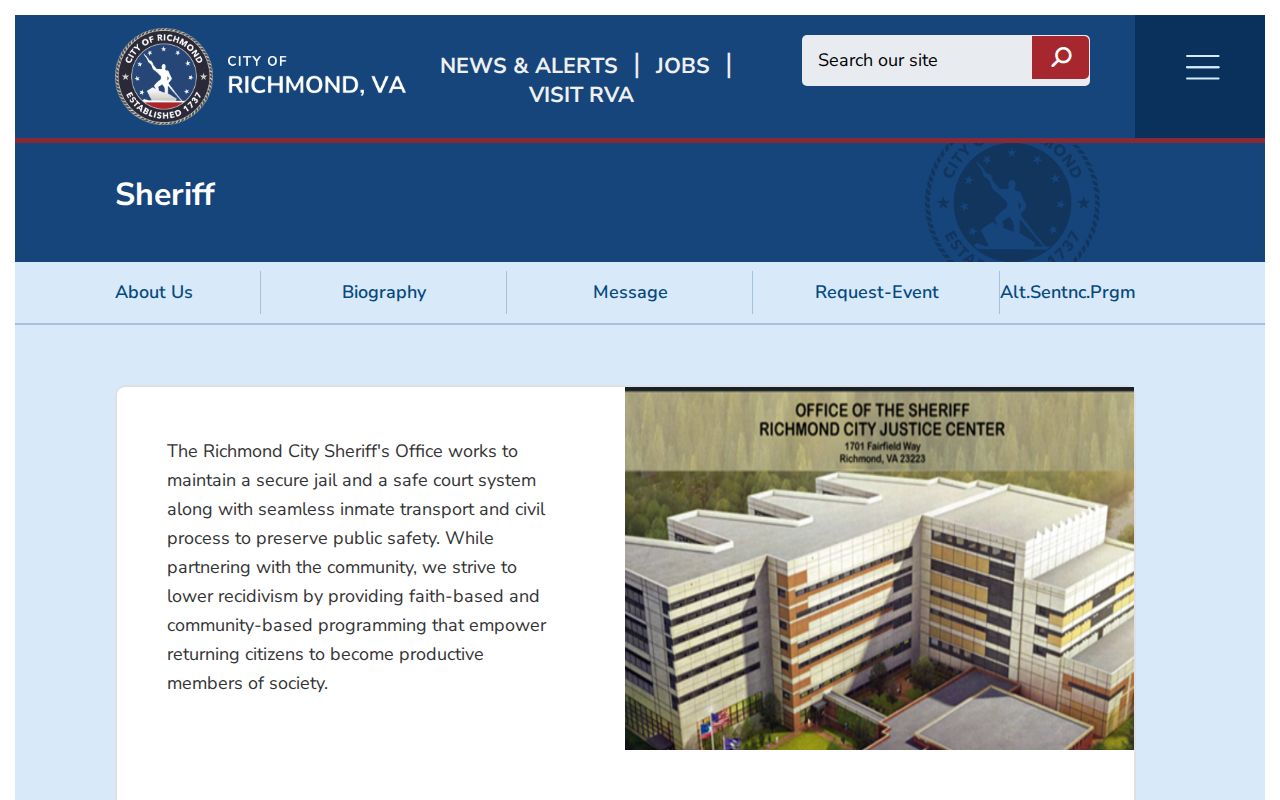
The Sheriff page is the correct local starting point, but its current roster must be paired with another record after a name disappears.
Richmond City VADOC Release Lookup
The Virginia Department of Corrections calls its tool the Inmate & Supervisee Locator. It covers more than prisons. Results may include people in state institutions, VADOC-authority placements in local or regional jails, institutional hospitals, Community Corrections Alternative Program placements, and people supervised on probation or parole. A Richmond District 1 result can confirm that prison confinement ended while state supervision continues.
| Search field | Required or optional | Use |
|---|---|---|
| First name | First three letters with full last name | Name route when DOC ID is unknown |
| Last name | Full name on the name route | Primary identity match |
| DOC ID | Seven digits as an alternate route | Best match when known |
| Location | Optional | Narrows a common name |
| Race, gender, age range | Optional | Helps separate similar results |
The locator updates daily and warns that data may be inaccurate or outdated. It does not promise a permanent archive after all custody and supervision end. A no-result is not a certified discharge. Ask VADOC or the sentencing court for a durable record when final discharge must be confirmed. The landing page also does not promise a projected-release label on every result, so use only the wording shown on the actual person’s record.
Richmond City Court Release Records
Richmond release verification may require both adult courts. General District Court handles misdemeanors and the preliminary stages of felony cases. Circuit Court handles felony trials and dispositions. A case can therefore begin in one court and continue in the other. Search by Richmond locality and match the party and case identifiers. Useful entries include bond action, dismissal, plea, sentence, suspended time, probation, appeal, and transfer activity.
The Virginia online case search preserves legal events that can outlast a jail stay.
The court entry explains why release may have been authorized, while the Sheriff release timestamp or VINE event confirms when physical custody changed.
Another hold can block discharge after a judge acts. A dismissal can end one charge while a second case remains active. Juvenile cases are not available in Virginia’s public online case systems, so a parent or guardian, counsel, the Juvenile and Domestic Relations District Court, or detention administration must use the authorized confidential route.
Note: Court authority and physical jail discharge are separate events, so confirm both when the exact release time matters.
Richmond City Release Notifications
Virginia Jail VINE covers all local and regional jails, including RCJC. Select Virginia, search for the exact person, compare identifiers and facility, then open the correct record. Registration is needed for automated notice. Offered channels may include phone, email, text, TTY, or the app. Telephone registration uses a PIN, which must be entered to acknowledge an automated call.
A VINE event may report release, transfer, death, or escape. Preserve its exact wording. A Richmond jail “release/transfer” alert can mark a VADOC handoff rather than a walk into the community. Jail VINE registration does not follow a person into VADOC notification. VADOC/NAAVI is separate, as is registry notification. BOP and ICE also remain outside VINELink.
Can an old VINE search prove release? Not reliably. Virginia publishes no guaranteed post-release search-retention period. Use VINE for a prospective alert, then obtain the Sheriff record for retrospective proof.
Note: Register while the correct Richmond City jail record is still searchable, and keep the confirmation with any later event message.
Richmond City Release Reentry
Post-release supervision depends on the order. Richmond Justice Services handles locally ordered pretrial and local probation programs. VADOC District 1 handles state probation and parole in Richmond. The Virginia Parole Board makes parole decisions, while VADOC sets and administers the actual release and field supervision. A parole grant is not the release event. Virginia law generally gives VADOC time to set the date after notice of a grant.
RCJC’s reentry work is unusually specific. The Sheriff documents case planning, birth-certificate help, DMV information, home-plan preparation, supervision seminars, family-reunification seminars, resource fairs, and voluntary G.R.A.C.E. recovery programming. Those services can help someone prepare documents and a workable plan before leaving custody. They do not change the release record, court order, or terms of supervision.
The VADOC probation and parole page explains the state supervision roles. Richmond District 1 is the local state contact at 6866 Everglades Drive, Richmond, VA 23225, 804-786-0251. Call RCJC Records for a jail release, Richmond Justice Services for local pretrial supervision, and District 1 for a state community placement.
Richmond City Release Transportation
GRTC identifies stop 880 as “FAIRFIELD WAY + ENTRANCE TO CITY JAIL” and associates the Justice Center with Route 7A. That creates a public-transit option directly at the jail entrance. Check the live GRTC schedule on the day of travel because service can change. No official fixed release hour, designated family waiting area, rideshare point, or exit policy was located.
Transportation planning should follow confirmed physical discharge, not an expected court action. A court order may still need to reach RCJC, be verified, and pass a hold check. Family or support contacts should avoid relying on a guessed morning, evening, weekend, or holiday time. The jail’s main information number is the sound source for current instructions.
Note: Check Route 7A service live on the release day because no fixed RCJC discharge schedule is published.
Richmond City Federal Release Search
The BOP locator covers federal inmates from 1982 forward. Search by register number or by name with age, race, and sex refinements. A result can show name, register number, age, race, sex, release date, and location. “Released” or a past release date without a facility means the person is no longer in BOP custody. It does not rule out another authority or federal supervised release. “In transit” is not release, and “unknown” means the term is not determined.
ICE’s Online Detainee Locator System is distinctive because it includes current detainees and people released from ICE custody within the prior 60 days. Search by nine-digit A-number and country of birth, or by exact name and biographical fields. It excludes people under 18. An ICE release result does not prove a return to Richmond. Removal, transfer, another agency’s custody, or a changed status may follow.
USMS manages federal pretrial custody and transport but has no matching public released-person archive. A transfer from RCJC to USMS remains custody. Use the federal docket, known holding facility, BOP when applicable, or a focused DOJ or USMS records request. No official evidence shows an RCJC immigration contract merely from a reported USMS inspection.
Note: ICE’s 60-day released-person window describes ICE custody only and does not establish the person’s next location or authority.
Richmond City Release Source Comparison
Each system answers a different question. Choose based on legal custody, not where a person lives. The Richmond roster is local and current. VADOC covers state custody and active state supervision. Court records explain legal authority. BOP and ICE cover their own federal roles.
| Source | Best use | What a no-result means |
|---|---|---|
| Richmond JailTracker | Current RCJC custody | Release, transfer, lag, mismatch, or nonpublic record |
| RCJC release record | Durable local release timestamp and disposition | Ask about identifiers, retention, or another custodian |
| Virginia Jail VINE | Prospective local custody-event alert | Not proof of release after an unknown retention period |
| VADOC locator | State custody or active supervision | Not certified final discharge |
| Richmond courts | Bond, disposition, sentence, and probation authority | May reflect sealing, a different court, or identifier error |
| BOP or ICE | Relevant federal custody status | Does not settle another agency’s custody |
The best Richmond City released inmate search often uses one event source and one durable record. Where transfer is plausible, a third source from the receiving system may be necessary.
Richmond City Release Facilities
Richmond has one active adult local jail and one secure juvenile detention center. Their release paths and public access rules are not interchangeable. The adult facility comes first in a Richmond City released inmate search. Juvenile questions must remain within authorized confidential channels.
- Richmond City Justice Center
- Holds adults in local custody and some placements under other authority. Confirm release through RCJC Records, VINE, the court, and any receiving system.
- Richmond Juvenile Detention Center
- Holds youth in secure pre-disposition detention. Confirmation belongs with a parent or guardian, counsel, the J&DR court, or detention administration.
The Justice Center stands at 1701 Fairfield Way and maintains general information at 804-646-4464. The juvenile center is at 1700 Oliver Hill Way and can be reached at 804-646-2937. Neither a current roster result nor a booking image should be used as a substitute for the record showing how custody actually ended.